Capital Preferences · 2014–2024 · 2 min read
Matching Investors and Portfolios
Built deterministic AI to match investor preferences with bespoke portfolios.

The challenge
Advisers have long matched investors to portfolios through conversation. They ask about attitude to risk and retirement goals, then recommend a risk level: a strategic asset allocation across asset classes. That conversation bends toward the adviser and the outcome they have in mind, and a down market shows when they got it wrong. Investors in portfolios too aggressive for them feel pressure to sell. Communication breaks down, advisers get fired, and people move to conservative portfolios that lock in their losses and miss the recovery.
A digital journey makes this worse, because no adviser is there to say "stay the course". The portfolio had to fit the investor from the start.
I worked between enterprise clients and our research team. With clients, I worked out what they actually needed, since putting portfolios this personal into production is a compliance challenge for an enterprise. Our research team defined the methods, and I worked with our engineers to build the AI that optimises a portfolio to each investor's preferences, at scale.
The approach
Reading risk from real choices
Our research team defined how to turn each person's decisions in the risk activity into a utility function, a formula for how much loss they'll accept for a chance at more gain. I worked with our engineers to run it at scale. The activity asks about short-term scenarios on purpose, because short-term thinking drives the value-eroding decisions people make when markets fall.
Where the investor meets the market
We mapped that formula onto an efficient frontier, the portfolios that earn the most for each level of risk, to find where the firm's view of the market met the investor's way of taking risk. That point set the strategic asset allocation, the investor's long-term mix of shares, bonds and cash. Because every step is a calculation, the same choices always lead to the same portfolio.
Personal enough to pass compliance
Firms using direct indexing could build a true n=1 portfolio, while others could only customise off-the-shelf model portfolios for each investor. I worked with each firm to find the level of personalisation it could put into production, and we built the models to serve both.
Down to the fund
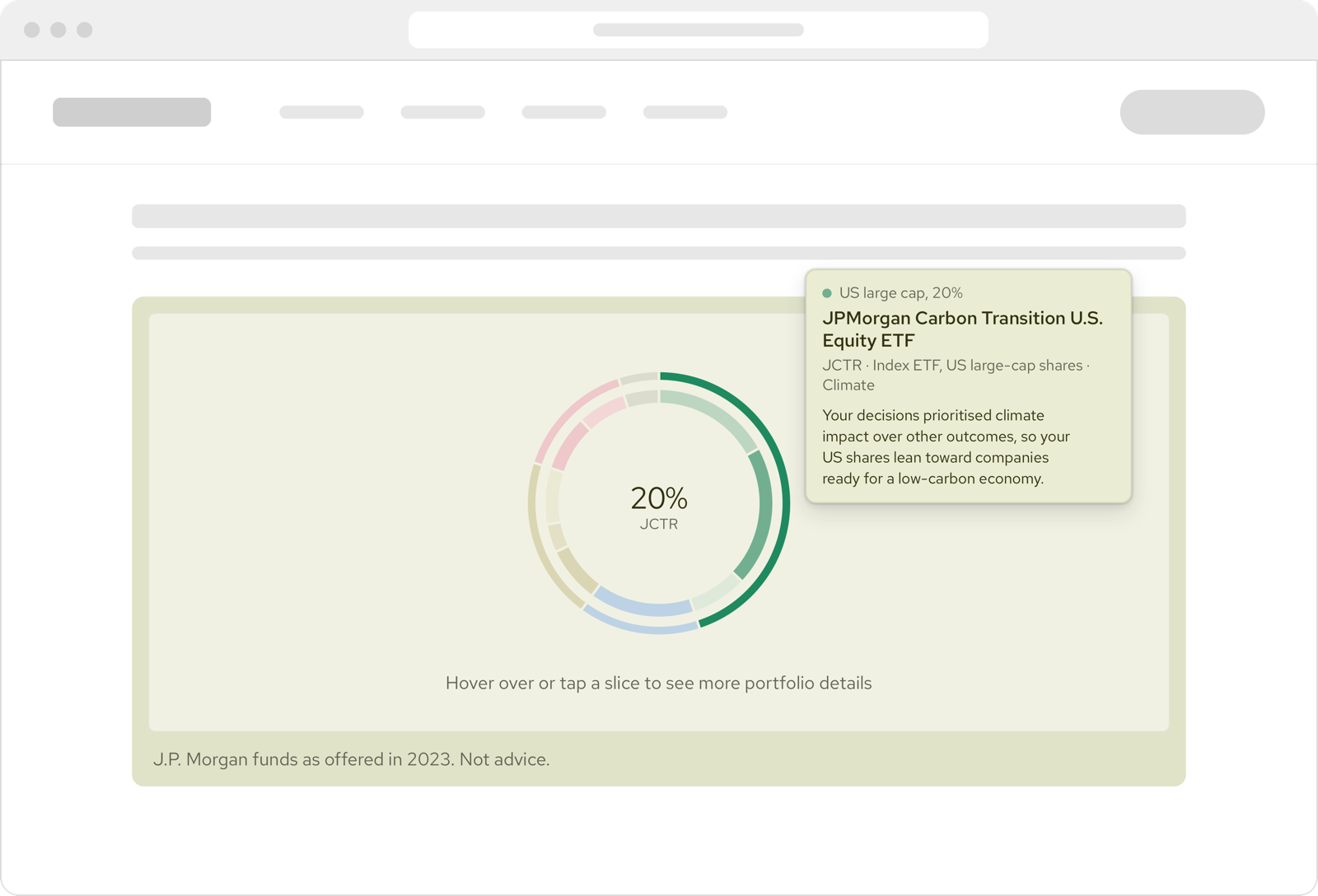
Adding ESG preferences took us past asset classes to specific funds. I worked with our research team to define how the models chose thematic funds and sized each one, so the portfolio held to the investor's risk preferences while reflecting what they cared about.
Hover over or tap a slice to see more portfolio details
J.P. Morgan funds as offered in 2023. Not advice.
The impact
- Advisers reported 30% more clients accepting their plan first time, with no changes.
- Moved advice from adviser-led conversations to data-led, personalised portfolios.
- The models sit behind 300K+ financial plans.