Capital Preferences · 2014–2024 · 1 min read
Commercialising Research
Turned an academic experiment into a risk activity investors chose 3 to 1 over psychology-based tools.

The challenge
Shachar Kariv's experimental economics research measures how people take risk by watching the choices they make in a simple game. The method was well proven in academia, but an experiment runs under different conditions from real life. Studies pay their participants, so they have every reason to finish. An investor on a firm's website has no such reason, and leaves as soon as the activity feels slow, confusing or dull.
That raised the bar far above anything the research had needed. We had to make it fast, fun and easy to understand, and it still had to measure exactly what the experiments measured.
The approach
Designing it myself
We tried a couple of agencies, but neither found the way forward, so I designed it myself. I ran workshops to agree the design principles with the whole team, then designed the slider, its interactions and its look.
Rotating the research
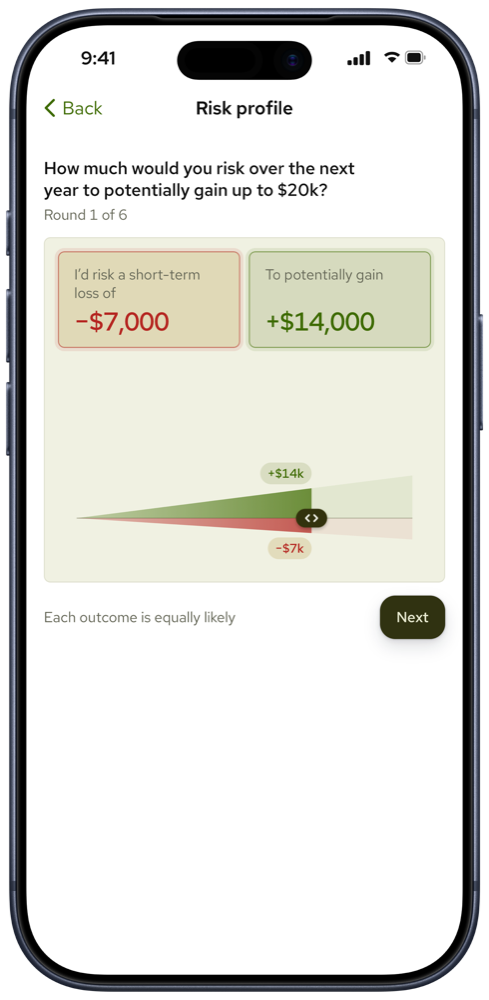
The experiments had people choose a point on a line across an x–y chart. I rotated that line into a single slider, a pattern people already knew from everyday interfaces, so each choice made sense at a glance.
Pick a point on the lineQuestion 1Outcome 1–Outcome 2–Each outcome has a 50% chanceHow much would you risk over the next year to potentially gain up to $20k?Round 1 of 6I’d risk a short-term loss of–To potentially gain–Each outcome is equally likelyMaking it fun
I gave it animation, colour and a lighter tone. People started asking for more questions, because they found the activity thought-provoking and challenging without it being difficult.
Proving it still worked
I ran rounds of qualitative testing to check that people understood it, enjoyed it and answered consistently. Then I put it in front of thousands of people in quantitative surveys, and their answers followed the same distribution as the academic research, so the redesign cost none of its validity.
The impact
- Asked to choose, investors preferred our activity 3 to 1 over legacy psychology-based risk tools.
- 300K+ investors have completed it.
- It became the foundation for every preference activity we built after risk.